
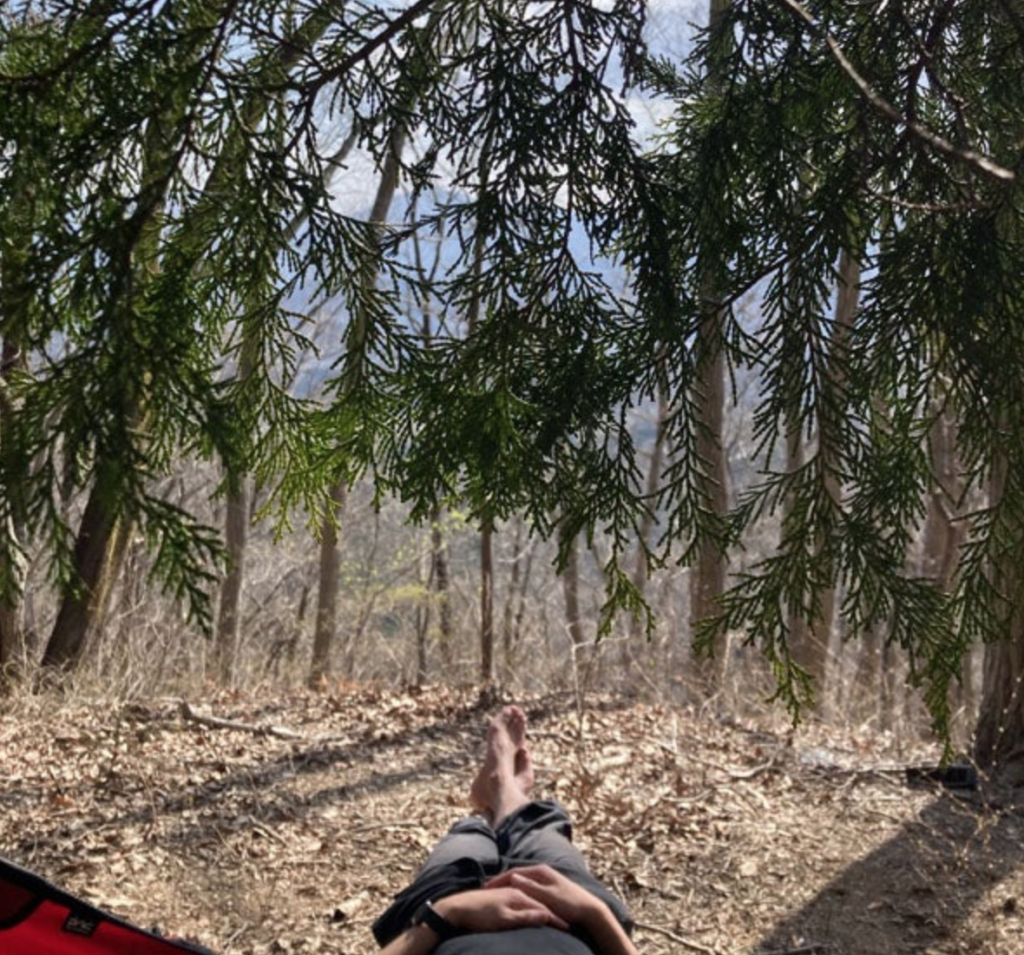
A Snowmelt Hike Becoming a Springtime Tradition
The early mornings of spring still carry a chill.
We meet in the bustling streets of Shinjuku, where the end of one workday and the start of another seem to cross paths.


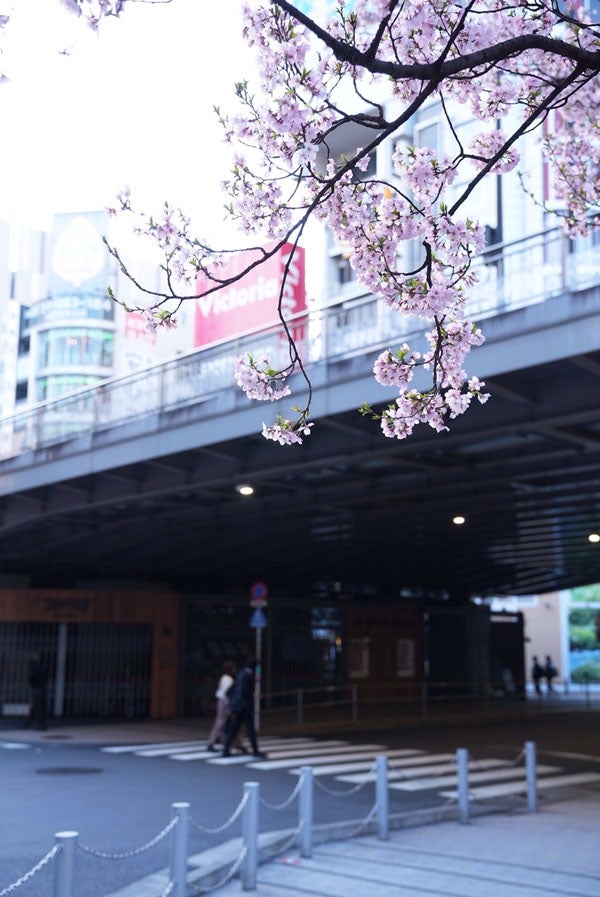
The sunrise after a long night out usually feels dreary—but this morning, it’s surprisingly refreshing.
A brand-new day begins.
We meet at Shinjuku South Exit.
“Excuse me!” I ask a tipsy lady nearby, who’s taking photos of the cherry blossoms, to press the shutter for us.

A classic “we’re off!” shot to start the day.
We did some quick shopping at Don Quijote in Shinjuku beforehand, picking up breakfast and some cup noodles for lunch.
When taking the rapid or express trains, there are often few transfer options—and near the destination, convenience stores or supermarkets can be scarce.
It’s one of those times when you think, “I should’ve stocked up earlier…” so definitely worth planning ahead.
Swaying gently on the rapid train,
I drift off for a nap while quietly ignoring the usual “I didn’t sleep at all” bragging contests.

What’s that streak of white in the sky, like a meteor?
By the time I wake up, we’re deep in the mountains.
From Shinjuku Station, we take the JR Chuo Line to Takao Station. Once there, we transfer to the JR Chuo Main Line and get off at Fujino Station.
The whole trip takes roughly 1 hour and 15 minutes.
From Fujino Station, it’s a short bus ride—about 5 minutes—to the trailhead of Mt. Jinba.
Heads up: this bus only runs about once an hour, so plan accordingly.
By chance, we arrive at Fujino Station almost exactly when the bus is about to leave—so it’s a mad dash, but we just make it in time.
You could walk to the trailhead, but the uphill stretches would likely tire you out later, so this time we take the bus (admit it—we’re lazy).

The bus is packed with fellow hikers, all heading toward the trailhead.
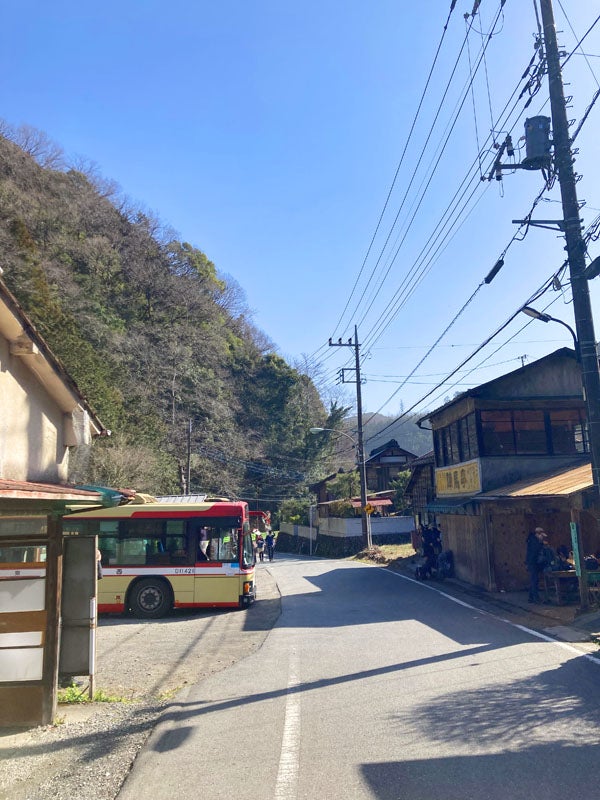
We’ve arrived at the trailhead of Mt. Jinba.

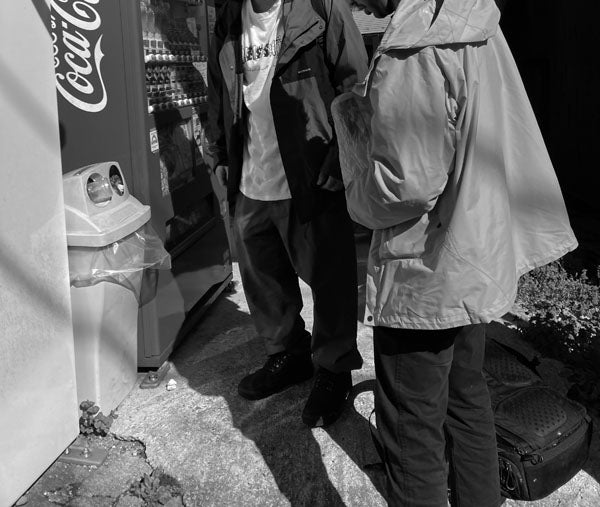
We stock up on 2–3 bottles of water from the vending machine.
Looking back, it was a good call—though you can buy water at the summit, it’s around 300–400 yen a bottle.
You’ll want at least 1.5L, especially if you plan to make cup noodles along the way.
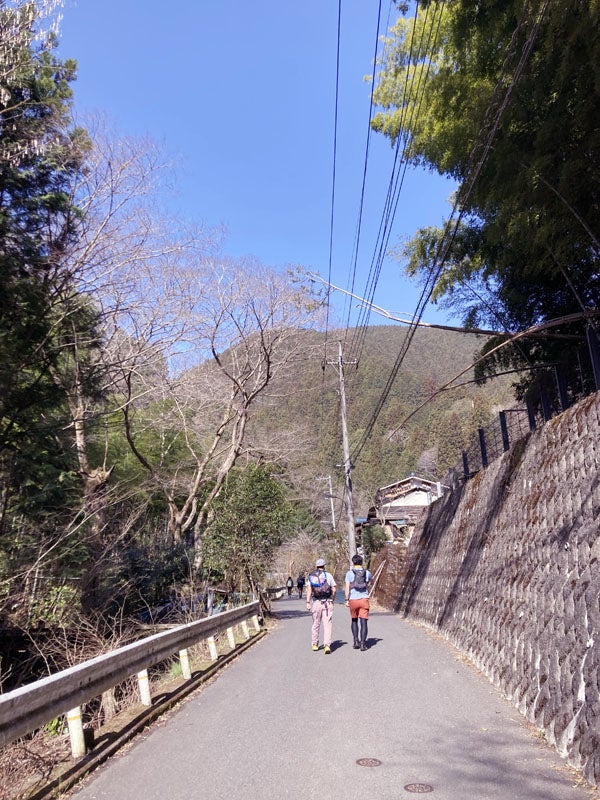
It’s starting to feel warm, so I switch into a short-sleeve shirt.
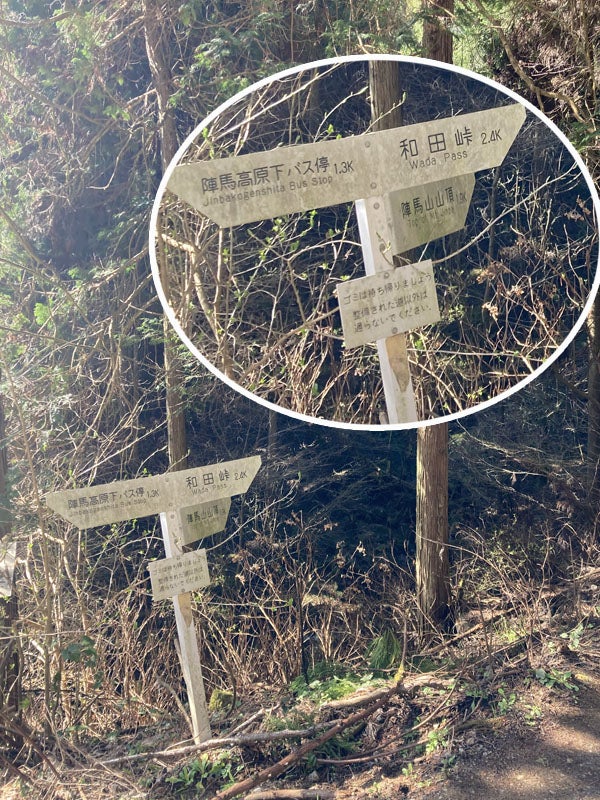
We’ve reached the trailhead—time to head up to the summit of Mt. Jinba!

Surrounded by the fresh scent of trees and crisp mountain air, I feel completely refreshed.
Alright, let’s get going!
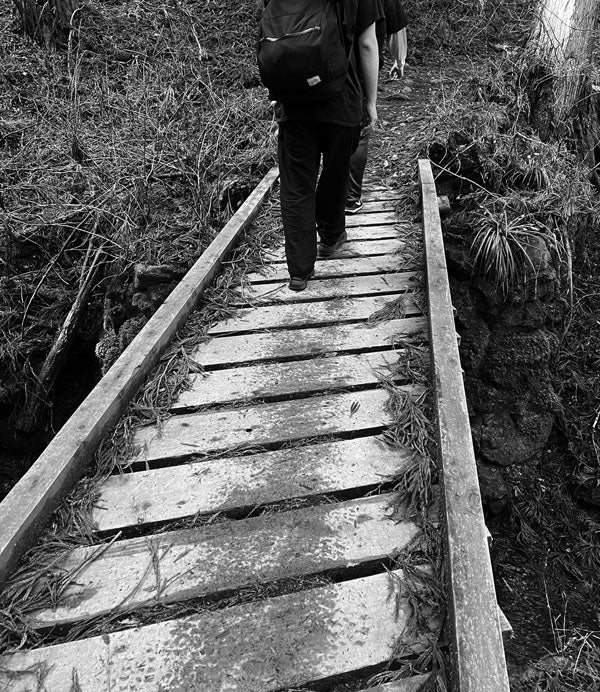


Our footsteps creak through the silent forest, echoing around us.
Along the way, everyone grabs a stick to use as a trekking pole.
Full disclosure: when I leaned on mine, it was rotten and snapped—sending me sprawling spectacularly. But let’s keep that between us.

The ups and downs on the trail are tougher than expected, and fatigue starts to build up.
Breathing gets heavier for those of us running low on energy.
Even the usual “I haven’t slept at all” bragging stops—everyone goes silent, just pushing onward up the trail.

Just 1 km to the summit.
Every time we pass a sign showing the remaining distance, it gives us a little boost to push onward.
Almost there…

The view is starting to open up.
Oh—this is it, isn’t it?

We’ve made it to the summit!!!!!

Phew——
I drop my backpack from my shoulders and take a deep breath.
A cool breeze brushes against my damp T-shirt, and it feels amazing.


Right in front of me, the majestic Mt. Fuji stretches across the horizon.
I didn’t expect to see Fuji today, so it feels like a little bonus treat.

I wonder what that is…

I guess it’s a horse because it’s Mt. Jinba.
Traditionally, the name “Jinba” comes from the historical practice of Takeda clan setting up camp (jin) to attack the Hojo clan, hence “Jinba-yama.”
In the late 1960s, Keio Railways promoted the area as a tourist spot and erected a statue of a white horse, which eventually became the symbol of the mountain and solidified the name Mt. Jinba. (Source: excerpt)


Feels like something you’d see at the Hakone Open-Air Museum.
At the summit, there are a few little tea houses—three in total—where you can grab a coffee or some wild vegetable soba while soaking in the views.
They even sell water and cup noodles.
After about a 15-minute break, we’re on the move again.
The summit isn’t really the destination—the real joy is chilling out at a campsite further along (though nobody asked me).
And look—found a hidden animal trail!

As we move further in…
Wow, this is the perfect spot!

We unpack our chairs and settle in for a lunch break.

Using the shade of the trees as a natural tarp,
We pull out the sneaky cans of beer we brought and make a toast.
Ahhh—this hits the spot.
Might even throw on some tunes while we chill.

Alright, let’s dig into this ramen!


When it comes to cup noodles on the mountain, curry is the only choice.
I dig in alongside the rice balls we picked up this morning—slurping away happily.
Everyone sips on an extra tea-hai, keeping hydrated while enjoying a leisurely break.
All while feeling the refreshing breeze on our faces…

Snooze time…
After a leisurely three-hour break (mostly just relaxing), it’s time to start heading back down.


If you’re paying attention, you probably know what the post-hike reward is…
That’s right—local hot springs! (Ready, set…)
A quick check on Google Maps to find the nearest onsen…
We veer off the original route, heading toward Wada and then descending toward Fujino Kita Elementary School.

We pass through a narrow path, barely 30 cm wide.
At first, we were constantly passing other hikers, but it seems we’ve veered onto a more obscure route…
With no one around, a bit of unease sets in, yet we keep pushing forward.
The footing is tricky and the slope steep—fatigue gradually builds.
After a while… the trail starts to open up.

A scene unfolds that feels straight out of a dream.
Cherry trees in full bloom appear as if celebrating our journey.

So quiet, all you can hear is the birds singing.

We finally reach the road and the bus stop in front of Fujino Kita Elementary School.
“Phew—finally here!” we say, dropping our packs and fanning our sweaty backs.
The plan was to take the bus to the hot springs (Jinba no Yu)…
We check the timetable again and again…
The bus isn’t coming for another 1 hour and 15 minutes. Wait, what!?
We’d expected maybe 30–40 minutes, but seriously…
Walking to the hot springs would take about 50 minutes. Hmm… tricky.
With darkness approaching, we reluctantly decide to walk.
50 minutes later…
Wait—isn’t that it over there!?

I loosen one shoulder strap of my backpack and untie my shoes, summoning the last of my energy while imagining the steam of the hot springs.


“Excuse me…”
Silence.
“EXCUSE ME!!!”
Still… silence.
And… that’s it. Sigh.
Before our spirits completely drop, we start scouting for a nearby hot spring.
Turns out there’s one just a 10-minute walk away.

It should be around here…

We’ve arrived!!
Looks like a ryokan… hope it’s all good.
Then we see the host spreading their arms in a welcoming “OK” sign.

Can’t help but throw up a fist pump.
After being at peak discomfort, a hot spring feels like heaven.
Even though it’s a ryokan, day-use of the onsen is available.
Jinba no Yu @ Ryokan Jinkeien / Sagamihara, Kanagawa
Hand over the 1000 yen admission fee, and we head straight for the bath.


Just a heads-up: it’s indoor baths only.
The bathing area isn’t huge, but we had it all to ourselves.
A bath after a hike really hits differently.
Rinse-in shampoo and body soap are provided,
but no towels—though you can purchase one if needed.
There’s also a hairdryer available.


Artist signatures are everywhere, haha.


Apparently, this area was used for filming Japan’s most popular comedy duo Downtown’s No Laughing series.

Looks like you can order a beer too, so we take a moment to relax.
A post-bath beer—does it get any better than this?

Absolutely heavenly.

Since there’s no bus, they offer to call us a taxi.

What a great soak.
It was the perfect one-day trip from Tokyo by train.
Mt. Jinba
An 855-meter mountain located on the border of Sagamihara City and Hachioji, Tokyo.
Ryokan Jinkeien
1848 Yoshino, Midori-ku, Sagamihara, Kanagawa, Japan